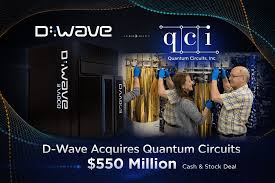
D-Wave’s $550 Million Acquisition Marks a Turning Point for Commercial Quantum Computing
D-Wave’s $550 Million Acquisition Marks a Turning Point for Commercial Quantum Computing
D-Wave Quantum’s agreement to acquire Quantum Circuits Inc. for $550 million represents a decisive strategic move that could significantly reshape the company’s long-term growth profile—and potentially the broader quantum computing market.
A Strategic Expansion Beyond Quantum Annealing
D-Wave has built its business around quantum annealing systems, which already generate revenue through enterprise and government customers in optimization-heavy industries. While this has positioned the company as one of the few quantum firms with real commercial traction, annealing alone limits addressable markets.
The acquisition of Quantum Circuits, a Yale University spin-out specializing in gate-model superconducting quantum computers, expands D-Wave’s technological scope into what investors widely view as the future of general-purpose quantum computing. Gate-model systems are essential for applications such as molecular simulation, cryptography, and advanced AI workloads—markets with significantly larger long-term revenue potential.
Why the Deal Matters Financially
The $550 million transaction—approximately $300 million in stock and $250 million in cash—reflects both conviction and urgency:
- Time-to-market acceleration: Acquiring a mature gate-model platform reduces R&D timelines versus in-house development.
- Portfolio diversification: D-Wave becomes a dual-platform provider, serving near-term optimization use cases while positioning for longer-term universal quantum computing.
- Competitive positioning: The deal places D-Wave in more direct competition with gate-model leaders, strengthening its strategic relevance in enterprise and government procurement cycles.
Management has indicated that early gate-model systems could reach customers as soon as 2026, a timeline that suggests a faster transition from research to revenue than previously anticipated.
Commercial Reality vs. Hype
For investors, it is important to separate hype from fundamentals. This acquisition does not instantly deliver fault-tolerant, universal quantum computers. However, it does signal that commercially useful quantum systems are becoming viable, particularly in hybrid classical-quantum environments where incremental advantages can justify enterprise spending.
The near-term opportunity lies in:
- Specialized, high-value workloads
- Government and research contracts
- Early enterprise adoption in materials science, logistics, and financial optimization
Risks to Monitor
Despite its strategic appeal, the transaction carries notable risks:
- Dilution from the stock component of the deal
- Execution risk in integrating two complex quantum technology stacks
- Extended monetization timelines for gate-model systems
Market volatility following the announcement reflects these concerns, but also underscores how closely investors are watching credible progress toward quantum utility.
Investment Takeaway
D-Wave’s acquisition of Quantum Circuits signals a shift from speculative quantum development toward measurable commercial intent. While broad quantum advantage remains a longer-term goal, this deal strengthens D-Wave’s positioning at the intersection of near-term revenue and long-term technological upside.
For investors, the message is clear: quantum computing is moving from concept to capitalization—and D-Wave is positioning itself to be one of the platforms that captures that transition.