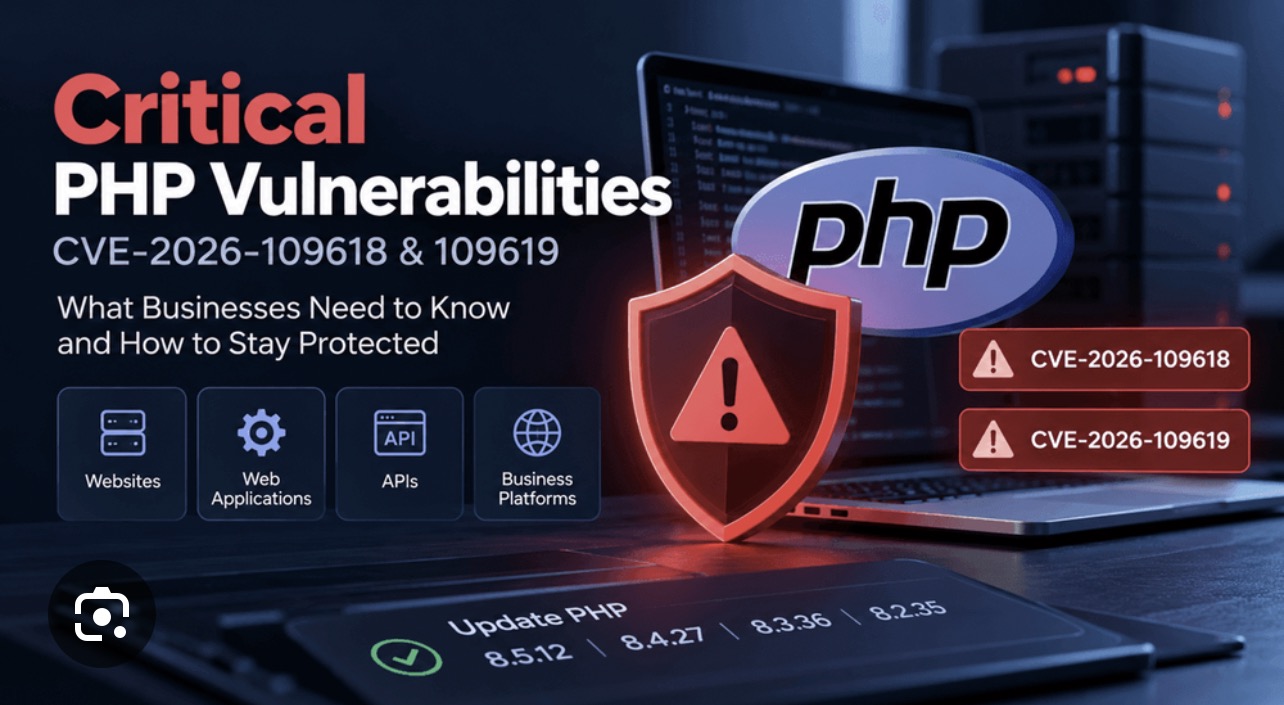
PHP vulnerabilities. Understanding the Risks and Protecting Web Applications
PHP Vulnerabilities: Understanding the Risks and Protecting Web Applications
Introduction
PHP is a widely used server-side programming language that powers websites, web applications, content management systems, and online platforms. Popular applications and platforms, including WordPress and Drupal, use PHP extensively.
Despite its popularity, PHP applications can become targets for cyberattacks when they contain vulnerable code, use outdated software, or lack appropriate security controls.
A PHP vulnerability is a security weakness in the PHP language, its runtime, an extension, or an application written in PHP that an attacker may exploit to compromise a system, access sensitive information, or disrupt services.
Understanding these vulnerabilities is essential for developers, cybersecurity professionals, vulnerability management teams, and organizations responsible for protecting public-facing applications.
1. What Causes PHP Vulnerabilities?
PHP vulnerabilities can arise from several sources:
- Outdated PHP versions: Older versions may contain publicly disclosed security weaknesses that have been corrected in newer releases.
- Insecure application code: Poor input validation, unsafe file handling, and improper authentication can create opportunities for attackers.
- Vulnerable third-party components: Plugins, frameworks, and libraries may introduce weaknesses into otherwise secure applications.
- Incorrect server configurations: Exposing sensitive files, enabling unnecessary functions, or granting excessive permissions can increase risk.
- Weak access controls: Poorly implemented authentication and authorization can allow unauthorized users to access restricted resources.
It is important to distinguish vulnerabilities in the PHP runtime itself from vulnerabilities in applications written in PHP. They may require different remediation approaches.
2. Major Types of PHP Vulnerabilities
Several types of vulnerabilities can affect PHP applications.
A. Remote Code Execution (RCE)
Remote Code Execution (RCE) occurs when an attacker can execute unauthorized commands or code on a remote server.
This is one of the most dangerous vulnerability types because successful exploitation can allow attackers to compromise a server, steal data, or establish unauthorized access.
Example: A vulnerable PHP runtime processes a specially crafted request that triggers a memory-management flaw, allowing an attacker to execute code on the server without logging in.
B. SQL Injection
SQL injection occurs when an application handles user input unsafely and incorporates it into database queries.
An attacker may manipulate database queries to access, modify, or delete information.
Potential impact:
- Exposure of customer information.
- Unauthorized access to database records.
- Modification or deletion of important data.
- Potential authentication bypass.
Prevention: Use prepared statements and parameterized queries instead of inserting user input directly into SQL commands.
C. Local and Remote File Inclusion
File inclusion vulnerabilities occur when an application allows user-controlled input to determine which files are loaded.
Local File Inclusion (LFI) can expose sensitive files on the server. Remote File Inclusion (RFI), where the relevant configuration and application behavior permit it, can allow external files to be loaded and potentially executed.
Potential impact:
- Exposure of sensitive system files.
- Disclosure of application configuration.
- Unauthorized code execution in certain circumstances.
Prevention: Avoid using untrusted input directly in file inclusion functions. Restrict file selection to an approved list of files.
D. Cross-Site Scripting (XSS)
Cross-Site Scripting occurs when an application displays untrusted content in a user’s browser without appropriate output encoding.
Attackers may use this weakness to execute malicious scripts in the context of a vulnerable website.
Potential impact:
- Theft of session information under certain conditions.
- Unauthorized actions performed through a victim’s browser.
- Phishing and manipulation of website content.
Prevention: Validate input where appropriate and apply context-appropriate output encoding. Use a Content Security Policy (CSP) as an additional protective measure.
E. Insecure Deserialization
PHP applications sometimes convert serialized data back into objects. If an application processes untrusted serialized data without appropriate safeguards, an attacker may manipulate the objects being created.
Depending on the application, this can result in unauthorized actions, denial of service, or code execution.
Prevention: Avoid deserializing untrusted data. Where deserialization is necessary, enforce strict controls and use safer data formats where practical.
3. Critical PHP Vulnerabilities Disclosed in October 2026
As of October 23, 2026, two critical PHP vulnerabilities have recently been disclosed that organizations should treat as an immediate remediation priority.
The vulnerabilities are:
| Vulnerability | Description | Potential impact |
|---|---|---|
| CVE-2026-109618 | An out-of-memory handling flaw that can result in memory corruption. | Remote code execution under affected conditions. |
| CVE-2026-109619 | A use-after-free flaw involving internal request state that may remain accessible after its memory has been freed. | Remote code execution under affected conditions. |
Both vulnerabilities have been associated with the name php2shell. According to the PHP security team’s advisory, exploitation may allow an unauthenticated attacker to execute malicious code on a vulnerable server. That means the attacker may not need a valid username or password to initiate an attack.
The risk is particularly concerning for public-facing web servers because they accept requests from the internet.
The official PHP security announcement identifies the following fixed releases:
| PHP version branch | Fixed release |
|---|---|
| PHP 8.5.x | 8.5.12 |
| PHP 8.4.x | 8.4.27 |
| PHP 8.3.x | 8.3.36 |
| PHP 8.2.x | 8.2.35 |
Organizations should verify their exact installed versions and vendor guidance before upgrading. PHP 8.1 and older versions no longer receive fixes directly from the PHP project, although some vendors may provide backported security patches.
Why These Vulnerabilities Matter
Remote code execution can transform a software weakness into a serious security incident.
If an attacker successfully exploits a vulnerable server, possible consequences include:
- Installation of malicious software.
- Unauthorized access to sensitive information.
- Theft of application credentials and secrets accessible to the compromised service.
- Attempts to move from the compromised server into other internal systems.
- Service disruption and business downtime.
These are potential consequences, not proof that every vulnerable server has been compromised.
Organizations should also avoid assuming that a security scanner’s findings are limited to applications explicitly identified as PHP-based. Third-party products, containers, appliances, and bundled software may contain PHP components that require assessment.
4. How Attackers Exploit PHP Vulnerabilities
A typical attack may follow several stages.
Stage 1: Reconnaissance
The attacker identifies public-facing websites, web servers, software versions, and exposed services.
Stage 2: Vulnerability identification
The attacker looks for known weaknesses in PHP, application code, plugins, or supporting components.
Stage 3: Exploitation
The attacker sends requests or data designed to trigger the vulnerability.
Stage 4: Initial access
If exploitation succeeds, the attacker may gain unauthorized access or execute code with the privileges of the affected service.
Stage 5: Post-exploitation
Depending on the access obtained, the attacker may attempt to steal data, install malware, establish persistence, or move laterally to other systems.
Stage 6: Detection and response
Security teams investigate suspicious activity, determine the extent of the compromise, contain affected systems, and remediate the underlying weakness.
Not every attack follows this exact sequence, but the model helps security teams understand where preventive and detective controls can interrupt an attack.
5. How Organizations Should Detect PHP Vulnerabilities
Organizations should use multiple security controls to identify PHP vulnerabilities.
Vulnerability scanning
Use vulnerability scanners to identify outdated PHP installations, known CVEs, and vulnerable components.
Examples of vulnerability management tools include:
- Tenable.
- Qualys.
- Rapid7 InsightVM.
Scanner results should be validated against the actual installed version and the relevant vendor advisory.
Software composition analysis
Software composition analysis (SCA) identifies vulnerable third-party libraries and dependencies within applications.
This is important because an application may use vulnerable components even when its primary PHP runtime is up to date.
Security monitoring
Monitor web server logs, application logs, endpoint detection alerts, authentication events, and unexpected processes.
Potential warning signs include unusual requests, unexpected command execution, unfamiliar files, suspicious outbound connections, and unexplained changes to application behavior.
Application security testing
Static Application Security Testing (SAST) examines source code for security weaknesses.
Dynamic Application Security Testing (DAST) tests a running application for security issues.
Using both approaches can help organizations detect weaknesses in application code and runtime behavior.
6. Best Practices for Remediating PHP Vulnerabilities
Effective remediation requires more than simply identifying a vulnerability. Security teams must ensure that the corrective action has been implemented and verified.
Step 1: Identify affected assets
Determine which servers, applications, containers, and third-party products use PHP.
Maintain an accurate inventory of internet-facing and internal assets.
Step 2: Validate the vulnerability
Confirm the installed PHP version, affected component, applicable vendor advisory, and availability of a security fix.
Avoid assuming that every scanner finding is accurate without checking the relevant technical evidence.
Step 3: Prioritize remediation
Prioritize vulnerabilities using factors such as:
- Severity and potential business impact.
- Whether the system is accessible from the internet.
- Whether authentication is required for exploitation.
- Availability of public exploit code or evidence of exploitation.
- Exposure of sensitive information.
- Criticality of the affected application.
For the two critical October 2026 PHP vulnerabilities discussed above, internet-facing systems should receive urgent attention.
Step 4: Apply security updates
Upgrade affected PHP installations to the appropriate fixed release, or apply a vendor-supported security update where the software is bundled with another product.
Test changes in an appropriate environment when feasible, while avoiding unnecessary delays in addressing critical exposure.
Step 5: Validate remediation
After patching, verify that the correct version or vendor fix is installed.
Rescan the affected assets and investigate any remaining findings. Confirm that the vulnerability is no longer present rather than relying solely on a change ticket marked as completed.
Step 6: Monitor for compromise
Patching closes the identified vulnerability but does not automatically remove evidence of an earlier attack.
Review relevant logs and endpoint alerts. If compromise is suspected, initiate incident response, contain affected systems, preserve evidence, and investigate the scope of access.
If immediate patching is impossible, consider isolating exposed systems from public networks until a fix can be applied. Temporary controls should not be treated as a permanent replacement for the required security update.
7. How Vulnerability Management Teams Should Measure Success
Organizations should track measurable indicators to determine whether their PHP vulnerability remediation program is effective.
Useful metrics include:
- Mean Time to Remediate (MTTR): The average time required to fix vulnerabilities.
- Remediation SLA compliance: The percentage of vulnerabilities fixed within their required deadlines.
- Vulnerability aging: How long vulnerabilities remain unresolved.
- Critical vulnerability backlog: The number of outstanding critical vulnerabilities.
- Internet-facing exposure: The number of externally accessible assets with known, unresolved vulnerabilities.
- Remediation validation rate: The percentage of completed fixes confirmed through rescanning or other technical verification.
- Recurrence rate: The frequency with which previously remediated vulnerabilities reappear.
These metrics help security leaders identify bottlenecks, measure risk reduction, and hold asset owners accountable.
A successful remediation program should focus not only on closing tickets but also on reducing actual exposure and preventing recurring vulnerabilities.
Conclusion
PHP vulnerabilities remain an important cybersecurity concern because PHP supports a wide range of web applications and internet-facing services.
Weak application code, outdated software, vulnerable dependencies, and insecure configurations can expose organizations to data theft, unauthorized access, and service disruption.
The critical vulnerabilities disclosed in October 2026 demonstrate why organizations must maintain an accurate asset inventory, monitor security advisories, prioritize internet-facing systems, and apply security updates promptly.
For cybersecurity and vulnerability management teams, the goal is straightforward: identify the exposure, assess the risk, remediate the weakness, validate the fix, and monitor for signs of compromise.
The most important lesson is that vulnerability management does not end when a patch is deployed. It ends only when the organization has verified the remediation and addressed any resulting security risk.